

- Description
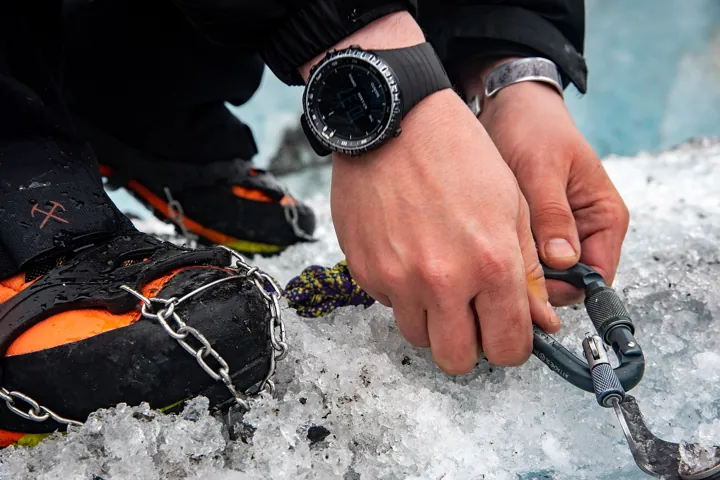
- Mains d'un alpiniste refermant un mousqueton sur la corde, crampons aux pieds, sur la glace d'un glacier.
- Source
- TSgt Donald Hudson, USAF · original page
- Licence
- PD Public domain
 Team and Collaboration (EQU)
A project is first and foremost a set of people coordinating with each other. Most “technical” failures are coordination failures, knowledge concentrated in a single person…
Level: 🟢→🔴 · Code: EQU · Matrix: PI
Why this theme#
A project is first and foremost a set of people coordinating with each other. Most “technical” failures are coordination failures, knowledge concentrated in a single person, or chronic overload. The cost of a hero-dependent team is invisible as long as that hero is present, and brutal the day they leave or get sick. This theme measures sustainability and resilience, not self-reported well-being.
What this theme measures#
- Axis: from isolated hero to autonomous, sustainable team.
- Key indicator: bus factor (number of people whose loss would block the project), sustainable workload (overtime, turnover), self-reported team health.
- Unit: number of people; % of weeks in overload; health score /5 from a short survey.
The five levels#
| Level | Short name | Promise | Typical indicator (orders of magnitude) |
|---|---|---|---|
| 1 | Isolated heroes | Work moves forward thanks to a few key people; everything stops if they are unavailable. | Bus factor = 1 on critical topics |
| 2 | Known roles | Everyone knows what is expected of them; backups are possible but slow. | Bus factor = 2 on major topics |
| 3 | Functioning team | Regular rituals coordinate work; workload is sustainable; knowledge is shared. | Bus factor ≥ 2 everywhere; < 10% of weeks in overload |
| 4 | Measured team | Team health and flow are tracked; tensions are detected early; onboarding a newcomer is fast. | Productive onboarding in ≤ 4–6 weeks; non-forced turnover |
| 5 | Autonomous team | The team decides, organizes itself, and renews itself without performance loss; multiple people can cover each role. | Bus factor ≥ 3; stable performance during a departure |
Milestones by level#
| ID | Milestone | Verifiable evidence |
|---|---|---|
| PI-EQU-1.1 | Team members and their topics are listed. | Up-to-date org chart or allocation table. |
| PI-EQU-1.2 | A backup is known for each planned absence. | Vacation plan with backups. |
| PI-EQU-1.3 | Each person's work is visible to others (even roughly). | Shared task board. |
| PI-EQU-2.1 | Each role (product owner, developer, tester, operator) is described on one page. | Role sheets. |
| PI-EQU-2.2 | A regular team check-in exists (short, daily, or weekly). | Calendar; observed participation. |
| PI-EQU-2.3 | Critical topics have minimal recovery documentation. | Recovery sheets for the 5 critical topics. |
| PI-EQU-3.1 | Rituals (daily check-in, review, retrospective) happen and are used for decisions. | Meeting notes; decisions from rituals. |
| PI-EQU-3.2 | The bus factor is assessed by topic and is at least 2 on critical topics. | Skills × people matrix. |
| PI-EQU-3.3 | Workload is planned with buffer; overtime is exceptional and tracked. | Planned load ≤ 70–80%; overrun log. |
| PI-EQU-3.4 | Working rules (definition of “done,” standards, peer review) are written by the team. | Accessible team charter. |
| PI-EQU-3.5 | Pair work or cross-review is practiced. | Review history by multiple people. |
| PI-EQU-4.1 | Team health is measured (regular short anonymous survey). | Results over ≥ 3 cycles. |
| PI-EQU-4.2 | Newcomer onboarding time is measured and follows a defined path. | Onboarding path; date of first deliverable. |
| PI-EQU-4.3 | Flow indicators (work in progress, cycle time) are used by the team, not against it. | Flow board; use in retrospectives. |
| PI-EQU-4.4 | Conflicts and tensions have an identified resolution channel. | Documented practice; example of resolution. |
| PI-EQU-5.1 | A departure or long absence does not durably impact delivery. | Flow comparison before/after a departure. |
| PI-EQU-5.2 | The team organizes its own internal priorities and pace within the set framework. | Internal decisions without management arbitration. |
| PI-EQU-5.3 | Skills are actively developed (training, rotation, mentoring). | Upskilling plan, tracked. |
| PI-EQU-5.4 | At least 3 people can cover each critical role. | Multi-skilling matrix. |
Detailed reading by level#
Level 1. Signs: the same person resolves every crisis; their vacation worries everyone. Benefit: short-term efficiency. Does not guarantee longevity. Difficulty: 1/5. Effort: 1/5.
Level 2. Signs: roles are clear, regular check-in, a few recovery sheets. Benefit: more clarity, fewer duplicates. Does not guarantee resilience when someone leaves. Difficulty: 2/5. Effort: 1/5.
Level 3. Signs: the team shares knowledge; cross-reviews are normal. Benefit: continuity in case of absence, increased quality. Does not guarantee satisfaction: a team can function while slowly wearing out. Difficulty: 3/5. Effort: 3/5.
Level 4. Signs: health survey, onboarding path, flow indicators. Benefit: tensions are seen before resignation. Does not guarantee individual goodwill. Difficulty: 4/5. Effort: 3/5.
Level 5. Signs: a departure does not show in the metrics, the team self-organizes. Benefit: resilience and attractiveness. Does not guarantee alignment with strategy. Difficulty: 5/5. Effort: 4/5. Level 5 is difficult in small teams (impossible to have three people per role in a five-person team).
Partial achievement and rating#
Common rule: see README.
- 0.5: practice present for the majority but not all critical topics; health survey done once.
- 1: evidence covers critical topics, observed over at least three cycles.
- A partial 5: bus factor of 2 everywhere, measured onboarding path, one departure absorbed with no visible loss; in a five-person team, this is an excellent result. Score ≈ 4.2.
6-person datamart team. Skills matrix: nightly consolidation, installation kits, and semantic model are each mastered by only one person (bus factor = 1 on three critical topics). Action: rotating pairing and recovery sheet; one year later, 2 out of 3 are covered.
Valued hero. Symptom: the person who saves deliveries gets promoted, so the pattern continues. Cause: heroics are rewarded, invisible prevention is not. Remedy: reward the absence of crises, measure bus factor.
Goodhart: a health survey score used as a manager target generates complacent answers. Keep it anonymous and never tied to individual evaluation.
Overload is measured better by work in progress than by time: beyond two simultaneous topics per person, cycle time rises quickly (well-known saturation effect in queueing theory).
Move to the next level#
Possible means (optional)
- 1 → 2: role sheets, 15-minute daily check-in, written backups.
- 2 → 3: Scrum rituals or equivalent (see Scrum Framework (Scrum Guide 2020) and Scrum in Practice), peer review, team charter, skills matrix.
- 3 → 4: short health survey, onboarding path, flow board (Project Metrics and Reporting).
- 4 → 5: rotation, mentoring, delegated decisions, skills plan (Agile and Lean Methods (Manifesto, Kanban, XP, Lean, Shape Up, DSDM, SAFe, DevOps…)).
An assistant increases individual capacity (review, documentation, code recovery), which can reduce dependence on an expert; it can also mask a real skills gap and create new dependency. See AI for Project Management (General, Then Data).
See also#
- Related themes: 05 Risks · 07 Stakeholders and Communication · 10 Continuous Improvement · 02 Governance.
- Other matrices: Documentation and Knowledge Transfer (DL) · Developer Experience and Flow (DL) · Adoption and Change Management (data).
- Practice: Scrum Framework (Scrum Guide 2020) · Scrum in Practice · Project Management Fundamentals · Glossary.
✻ Written by Claude Sonnet 5.5
