

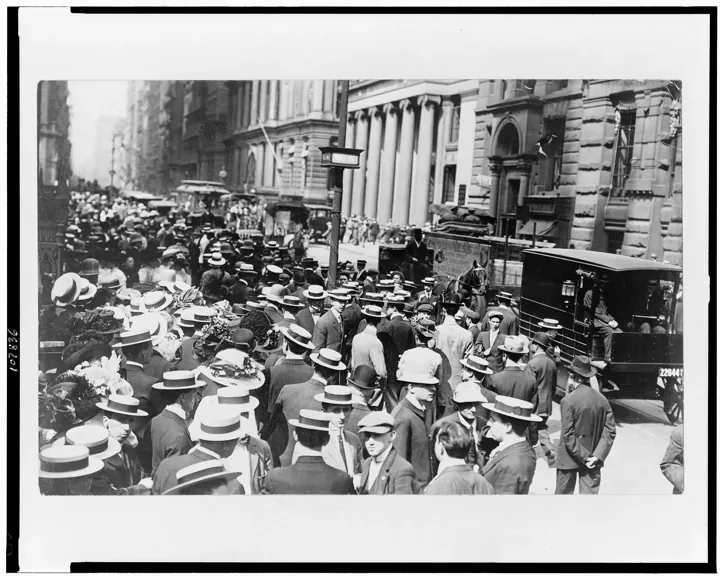
- Description
- Foule dense de passants en canotiers et chapeaux, sur un trottoir de Wall Street
- Source
- George Grantham Bain Collection (Library of Congress) · original page
- Licence
- PD Public domain
 The bystander effect
When everyone sees the problem, each person assumes someone else has already handled it.
In brief
- What: when a problem is visible to several people, the probability that one of them acts goes down.
- Why: diffusion of responsibility, looking to others to determine whether there is urgency, fear of being wrong in front of others.
- Detect: an alert seen by twenty people without anyone reporting it; “someone has probably already flagged it.”
- Avoid: one named owner for each issue, call out one specific person, a simple alert channel, the norm “we report it, even if it’s a duplicate.”
Definition#
 Fictitious illustration
 Fictitious illustration
The bystander effect refers to the fact that the probability that a person intervenes or reports a problem decreases as the number of witnesses increases. It was described in 1968 by social psychologists John Darley and Bibb Latané, following the 1964 Kitty Genovese case (see the case below, which restores what we actually know about it).
It does not say people are indifferent. It says that, in a group, each person’s action depends on what they believe others are doing or will do.
The mechanism#
Latané and Darley (1970) describe a sequence of decisions, each of which can fail: noticing the event, interpreting it as an emergency, feeling responsible, knowing how to help, deciding to act. The presence of other people affects several links in the chain:
- Diffusion of responsibility. Alone, you are the only person who can act; with twenty people, responsibility is spread out, so each person carries less of it.
- Pluralistic ignorance. Each person looks to others to judge whether it is serious; seeing calm, passive people, they conclude it is not serious, while the others are doing exactly the same thing. Everyone reassures themselves based on everyone else’s apparent calm.
- Fear of judgment. Triggering an alert by mistake in front of others is embarrassing: people wait for someone more legitimate to handle it.
Students discuss their college life over an intercom, each in a separate room. One “participant” (recorded) simulates a seizure and asks for help. Depending on the condition, the real participant believes they are alone with the victim, with one other witness, or with four. The more witnesses they believe are present, the less likely they are to report the seizure and the longer they delay: about 85% report before the end of the seizure when they believe they are alone, about 62% with three people, and 31% with six. Participants who did not respond were not indifferent: many were visibly tense, which reveals inner conflict rather than disinterest.
The simulated seizure crisis (1968)
Loading the chart…
View the data
| Alone | With three | With six | |
|---|---|---|---|
| Alone with the victim | 85 | - | - |
| One other witness | - | 62 | - |
| Four other witnesses | - | - | 31 |
Where you encounter it#
In project management#
- Monitoring alerts: an indicator is flashing in a channel followed by twenty people; each person assumes the on-call team has been notified.
- Failed pipeline: the build has been red for three days; “everyone sees it.” No one opens a ticket, no one fixes it.
- Technical debt and known defect: a workaround is known by the whole team, never addressed, because it is no one’s task.
- Code review and acceptance testing: with three reviewers, each person reviews less carefully assuming the other two will catch the problem.
- Live incident: twenty people in the crisis channel, but no one says “I’ll take it” or “I’ll notify the customer.”
In management#
- Team meeting: a decision to make or a person in difficulty is visible to everyone; no one brings up the problem.
- Problematic behavior: a colleague is treated harshly in a meeting; each witness waits for someone else to react or for the manager to step in.
- Follow-up actions: “someone should…” at the end of a meeting: without a name or date, nothing gets done.
- Risk known to all: all members of a department know a procedure is being bypassed; no one informs leadership.
Famous cases#
The Kitty Genovese case: what is established March 13, 1964#
Bias at play: bystander effect (at the starting point of the research), but a story that was heavily distorted.
The common version. Kitty Genovese, 28, is stabbed on the night of March 13, 1964, near her home. Two weeks later, the New York Times publishes an article titled “37 Who Saw Murder Didn't Call the Police” (the number is quickly corrected to 38): thirty-eight neighbors allegedly watched the attack from their windows for half an hour without reacting. The story becomes a symbol of urban apathy and inspires Darley and Latané's research.
What we know. In 2007, psychologists Rachel Manning, Mark Levine, and Alan Collins revisited court and police archives. Their conclusion: the account is largely inaccurate. The assault took place in several locations and at different times, at night, with poor visibility from the buildings; few neighbors saw what was actually happening, many heard screams without understanding it was an assault. At least one neighbor called the police, and a friend, Sophia Farrar, ran to Kitty Genovese and held her in her arms until help arrived. The figure of 38 witnesses was never established. The case remains tragic, but it does not prove the mass indifference people read into it.
What this illustrates
Two lessons. First, a striking story is not evidence: the bystander effect is based on experiments, not on this news item. Second, the lesson is more useful than a case of “bad witnesses”: well-intentioned people do not act when the situation is ambiguous and responsibility is shared. Hence the need for an organization that names someone.
Heartbleed: everyone uses it, no one monitors it 2011-2014#
Bias at play: diffusion of responsibility (interpretation by analogy, not proven).
What happened. Heartbleed is a memory management error in OpenSSL, the encryption library used by a large part of the Internet. It made it possible to read secret information (keys, passwords) in memory. The code was added in late 2011 and released in March 2012; the vulnerability was discovered and publicly disclosed in April 2014, after about two years of exposure. In hindsight, the project, used by millions of sites but maintained by a handful of contributors, was described as an example of infrastructure everyone depends on and no one is tasked with funding or reviewing. A few weeks later, the Linux Foundation launched the Core Infrastructure Initiative to support such projects.
What this illustrates
This case is an analogy, not a demonstration: we cannot prove that each user assumed someone else was reviewing the code. But it illustrates what the effect predicts: a critical component, shared by everyone and with no clear owner, receives less attention than if it had a designated person in charge. At your organization: who is responsible for this library, this script, this expiring certificate?
The Le Scouarnec case: each institution could believe another would act (France) 2006-2025#
Bias at play: bystander effect, diffusion of responsibility across institutions.
What happened. In 2006, the alert about surgeon Joël Le Scouarnec's conviction reaches Quimperlé hospital management, the Finistère Medical Association, and local health authorities. The Medical Association, which at the time had no disciplinary power over hospital doctors, notifies the DDASS; no action is taken. The surgeon continues practicing, in Quimperlé then Jonzac, until his arrest in 2017. He is definitively convicted on May 28, 2025, for 299 victims. In its September 8, 2026 communication, the National Assembly fact-finding mission describes a “system blocking the circulation of information”: no exchanges between professional orders, Article 40 of the Code of Criminal Procedure insufficiently applied, FIJAIS consulted at hiring but no longer afterward.
Where the bias comes in. The bystander effect describes the drop in individual action when multiple people can act: each assumes another will handle it. The documents establish the structure (multiple informed institutions, each referring to another, none considering itself solely responsible); they do not establish what each person thought. The institutional explanation is dominant: a breakdown in information flow and authority, which the bias describes without fully explaining. Level of evidence: accepted, not proven. Diffusion of responsibility across institutions is documented; interpreting it as a bystander effect is a reading.
What this illustrates
When several actors receive the same alert, designate one single person responsible for reporting what follow-up is carried out. An alert with no named owner gets no follow-up.
Detection signals#
- “Someone probably already reported it.” “I thought it was being handled.”
- The same problem is known by everyone and reported by no one.
- Meeting action items start with “we should…” and include no names.
- In an incident channel, many read, few write, and no one says “I'll take it.”
- The alert is raised only once it has become serious, or by an external person.
- The larger the team grows, the fewer spontaneous reports there are.
Avoidance reflexes#
- Name an owner. Every alert, component, risk, and action has a name and a date. A RACI has only one “R” (responsible) per line.
- Call on a specific person. “Julien, can you call the client?” gets better follow-through than “can someone call the client?”: that's the research lesson (designating someone removes diffusion of responsibility).
- Say “I'll take it.” During an incident, establish a ritual: the first person who takes the issue announces it; everyone else sees it's covered.
- Normalize reporting, even duplicates. A redundant report costs almost nothing; silence can cost a lot. Thank people for it, never criticize it.
- A simple, judgment-free alert channel. One button, one form, one number, accessible to everyone, including anonymously.
- Say what you see. Saying out loud “I can see the build has been red since yesterday” breaks pluralistic ignorance: others discover they aren't the only ones concerned.
- Acknowledgment deadlines. An alert not handled after N minutes is automatically escalated to a responsible person.
- Train for intervention. Knowing how to help increases the likelihood of acting (link 4 in the Latané and Darley model).
With AI: detect, fix, mitigate#
AI and automation are good remedies: a system that detects, assigns, and follows up is not subject to diffusion of responsibility. They can create the responsibility that's missing. Be careful, however, not to shift the problem: if “the system” monitors and no one is named to act on its alerts, you've simply added a bystander.
Detect#
- Spot, in ticket or alert history, old, known issues with no owner.
- Identify, in reports, actions with no name or deadline.
- Analyze an incident channel: who saw, who acted, and after how long.
Fix#
- Automatically assign each alert to a person or role, with timed escalation.
- Turn “we should…” statements from a report into named actions to validate.
- Draft a simple alert procedure and template messages.
Mitigate#
- Follow up on overdue actions, with a direct message to the designated person.
- Offer anonymous reports and summarize them.
- Produce an owner dashboard for components, scripts, certificates, and their deadlines.
Prompts to integrate into your practices#
1. From ownerless actions to named actions. Run at the end of a meeting on the raw meeting notes.
Here are the meeting notes: [text].
Extract all actions, explicit or implicit (“we should…”, “we ought to…”). For each one, provide: the action rephrased as an imperative, the most logical role to carry it (no invented name), a proposed deadline, and the question to ask to confirm who is taking it.
Flag actions for which no one seems responsible.
2. Audit of ownerless topics. On an anonymized export of tickets or alerts.
Here is a list of tickets, alerts, or risks (without names): [list, with opening date, status, assigned or not].
Identify those that are old, known by several people, and without a clear owner. Rank them by estimated risk with your justification, and propose for each a possible owner (a role) and a first action.
Specify what you cannot know from this data.
3. Simple alert procedure. To make reporting easy and judgment-free.
Our team of [size and context] lacks spontaneous reporting: problems are seen by several people but rarely escalated.
Propose a one-page alert procedure: one single channel, a three-line message template, a handling deadline, an escalation rule, and three sentences to use to thank someone or to say “I'll take it.” Include an anonymous mode.
How to integrate them#
- At the end of meetings: prompt 1 produces named actions; you confirm them out loud.
- Quarterly: prompt 2 serves as an audit of ownerless debt.
- When setting up a team: prompt 3 provides the foundation for an alert charter, which the team adapts.
Precautions#
- AI suggests owners, it does not appoint them: only management or the team can assign ownership.
- Do not replace speaking up with a bot: an automatic alert with no one acknowledging it adds noise.
- Avoid personal and confidential data in an unauthorized tool.
Limitations#
- A meta-analysis by Fischer and colleagues (2011, 105 studies) confirms the effect in non-dangerous and ambiguous situations, but greatly reduces it in clear, dangerous emergencies, especially when witnesses can help one another.
- CCTV footage of conflicts in public spaces (Philpot et al., 2020, 219 incidents in three cities) shows that at least one witness intervenes in about 91% of cases, and that the likelihood that at least one of them intervenes increases with the number of witnesses. The bystander effect is therefore not a universal law.
- The effect depends heavily on context: it weakens when witnesses know each other, when the situation is clear, and when helping requires little effort.
- Do not confuse it with social loafing (putting in less effort in a group): here, people do not know or do not feel obligated to act.
Sources and verification#
- Darley & Latané (1968), “Bystander intervention in emergencies: Diffusion of responsibility”, Journal of Personality and Social Psychology, 8(4), 377-383
- Latané & Darley (1968), “Group inhibition of bystander intervention in emergencies”, Journal of Personality and Social Psychology, 10(3), 215-221 — the study of the room filling with smoke.
- Latané & Darley (1970), The Unresponsive Bystander: Why Doesn't He Help?, Appleton-Century-Crofts.
- Manning, Levine & Collins (2007), “The Kitty Genovese murder and the social psychology of helping: The parable of the 38 witnesses”, American Psychologist, 62(6), 555-562
- Gansberg (March 27, 1964), “37 Who Saw Murder Didn't Call the Police”, The New York Times.
- Fischer et al. (2011), “The bystander-effect: A meta-analytic review on bystander intervention in dangerous and non-dangerous emergencies”, Psychological Bulletin, 137(4), 517-537
- Philpot, Liebst, Levine, Bernasco & Lindegaard (2020), “Would I be helped? Cross-national CCTV footage shows that intervention is the norm in public conflicts”, American Psychologist, 75(1), 66-75
- Heartbleed: heartbleed.com (Codenomicon) and OpenSSL's security advisory of April 7, 2014; Netcraft estimate, April 2014; Core Infrastructure Initiative (Linux Foundation) announcement, April 2014.
- French National Assembly, Law and Social Affairs Committees (2026), “Briefing on follow-up actions in the Joël Le Scouarnec case”, meeting of September 8, 2026 — describes the blockage of information flow between institutions and the insufficient application of Article 40.
- Allodocteurs, “Surgeon from Jonzac: what was the role of the authorities?” — timeline of the 2006 alert sent by the Medical Council to the DDASS, specialist press (secondary source).
See also#
Related biases#
Variants or cousins: not to be confused.
- The Bandwagon Effect (Trend Effect)
- Authority bias
- L'ignorance pluraliste (concept or method, no page)
Counterweights and related reflexes#
What neutralises it.
- La responsabilité nominative (RACI, propriétaire désigné) (concept or method, no page)
- L'astreinte avec un responsable unique (concept or method, no page)
- The devil's advocate
