

- Description
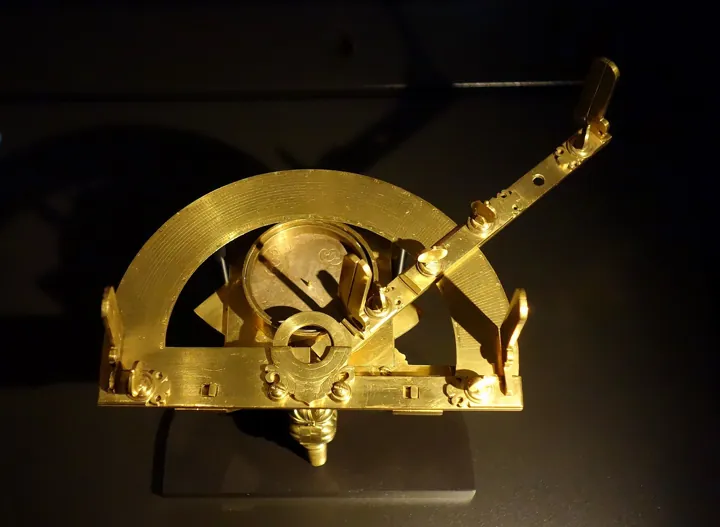
- Instrument d'arpenteur en laiton pour mesurer les angles : demi-cercle gradué et alidade.
- Source
- Daderot · original page
- Licence
- CC0 Public domain
 Assessment tool
This we do, this is improvable, this is to do: a precise assessment that calculates the levels and lists the next steps.
In brief
- 4 statuses: in place, improvable, to do, not applicable.
- 3 figures: guaranteed level, average level, gap.
- No data saved; download and comparison are optional.
This tool takes a precise stock of a BI product: for each criterion, what is in place, improvable, to do or not applicable. It derives the levels from that. It is not an evaluation: it describes, it does not grade.
Your data stays with you
Nothing is saved or sent: the assessment exists only in this page. Closing the page erases it (the browser warns you if you have entered anything). To keep it, use Download; to retrieve it, Open an assessment.
How to use it#
- Choose the theme (overview or the matrix of one theme: storage…) then a scope: a product, a version, a team. Give it a name (optional).
- Go through the dimensions and fill in the criteria from the bottom up. Rely on facts: a demonstration, a document, a log.
- Use “Not applicable” for what does not apply to your product: the criterion does not penalize the level.
- Read the summary: level by dimension, guaranteed level, average level, gap, and the list of what is improvable and to do for the next stage.
- Download your assessment to keep it or compare it with a later version.
The tool#
Reading the results#
- Level of a dimension: the highest level for which all the criteria, and those of the lower levels, are in place.
- Score: this level plus the completed share of the next level (in place = 1, improvable = 0.5, to do = 0).
- Guaranteed level: that of the weakest dimension. This is what you can count on in all areas.
- Average level: weighted average of the scores: it shows overall progress.
- Gap: difference between the most advanced and the weakest dimension; the larger it is, the more unbalanced the product.
The details and worked examples are in the calculation rules.
From assessment to roadmap#
- Identify the guaranteed level: the weakest dimension limits the product.
- Read the “To do” list: these are the criteria of the next stage of each dimension, hence the next steps.
- Choose according to value and risk: a weakness in security or quality comes before an advance in personalization.
- Address the “improvable” ones: often inexpensive, they consolidate a stage.
- Redo the assessment at regular intervals, and compare it with the previous one.
