

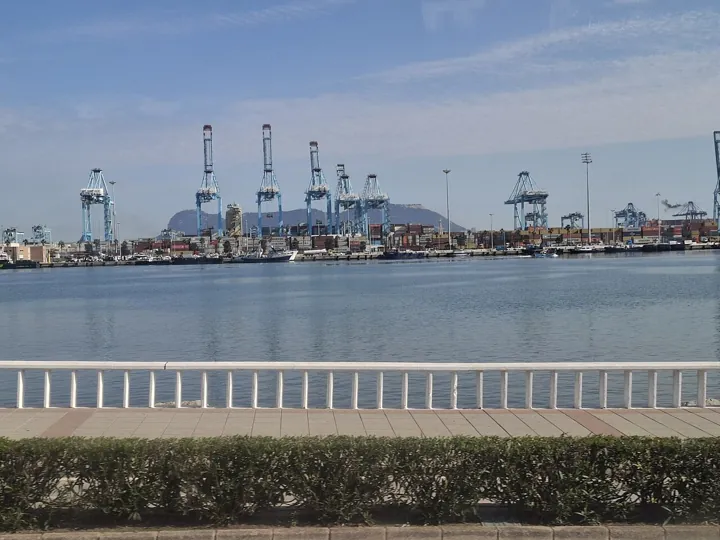
- Description
- Container port cranes
- Source
- Wikipek · original page
- Licence
- CC0 Public domain
 Matrix: Ingestion
How data from the source systems enters the product: knowledge of the sources, acquisition modes, change capture, contracts, schema evolution, security, monitoring.
In brief
- 8 dimensions, levels 0 to 5, 112 criteria.
- Tool: self-assessment, choosing "Ingestion".
- Levels and criteria: original synthesis, references cited at the bottom of the page.
The arrival of data: inventory of sources, acquisition modes (file, query, interface, change capture, stream), extraction windows, contract with the data provider, evolution of source schemas, secure access, monitoring of arrivals. What is done with the data once it has arrived falls under the "Storage" and "Processing" themes.
8 dimensions, six levels (0 to 5) and 112 observable criteria. To place your product: open the self-assessment for this theme. The calculation rules are here.
Overview#
Each cell is the level's signature for the dimension.
| Dimension | 0 · Handcrafted | 1 · Locally tooled | 2 · Shared | 3 · Industrialized | 4 · Integrated and governed | 5 · Autonomous |
|---|---|---|---|---|---|---|
| Source inventory | Sources known from memory, by the person who connected them. | List of sources. | Sheet per source. | Inventory kept up to date. | Governed inventory. | Inventory fed automatically. |
| Acquisition modes | Files received or retrieved by hand. | Scheduled retrieval. | Direct access to sources. | Mode chosen according to the source. | Heterogeneous sources unified. | Continuous acquisition. |
| Change capture at the source | Full copy of the source every time. | Detection by date. | Detection mechanism per source. | Reliable capture. | Complete, verified capture. | Near-continuous capture. |
| Scheduling and extraction windows | Extractions launched whenever convenient, sometimes in the middle of the source's peak activity. | Fixed times. | Agreed window. | Managed window. | Consistent extractions. | Adaptive extraction. |
| Data contracts | No agreement: you take whatever arrives. | Written expectations. | Delivery agreement. | Verified contract. | Negotiated and monitored contract. | Executable contract. |
| Evolution of source schemas | A structural change is discovered through a processing error. | Changes noticed. | Changes detected. | Changes absorbed. | Changes anticipated. | Changes steered. |
| Access and connection security | Connections with personal or over-privileged accounts, passwords in scripts. | Dedicated accounts. | Minimal rights. | Managed connections. | Managed identities. | Monitored connections. |
| Arrival tracking and freshness | The absence of data is noticed when a report is empty or wrong. | Manual check. | Arrival recorded. | Freshness measured. | Freshness published. | Delays anticipated. |
Dimensions of the global model most concerned: Data sources and flows, Data quality, Security and compliance and Support and observability.
Knowing and reaching the sources#
Source inventory#
Do you know which sources feed the product, where they come from and who answers for them?
| Level | Signature | Criteria to meet |
|---|---|---|
| 0 · Handcrafted | Sources known from memory, by the person who connected them. | Starting point: no criteria. |
| 1 · Locally tooled | List of sources. |
|
| 2 · Shared | Sheet per source. |
|
| 3 · Industrialized | Inventory kept up to date. |
|
| 4 · Integrated and governed | Governed inventory. |
|
| 5 · Autonomous | Inventory fed automatically. |
|
A question about the origin of a figure is answered in minutes, not days.
Acquisition modes#
By what means does the data arrive, and are they suited to each source?
| Level | Signature | Criteria to meet |
|---|---|---|
| 0 · Handcrafted | Files received or retrieved by hand. | Starting point: no criteria. |
| 1 · Locally tooled | Scheduled retrieval. |
|
| 2 · Shared | Direct access to sources. |
|
| 3 · Industrialized | Mode chosen according to the source. |
|
| 4 · Integrated and governed | Heterogeneous sources unified. |
|
| 5 · Autonomous | Continuous acquisition. |
|
Each source is reached by the most reliable means, without improvisation specific to one person.
Flows and reliability#
Change capture at the source#
Can you tell what has changed in the source since last time?
| Level | Signature | Criteria to meet |
|---|---|---|
| 0 · Handcrafted | Full copy of the source every time. | Starting point: no criteria. |
| 1 · Locally tooled | Detection by date. |
|
| 2 · Shared | Detection mechanism per source. |
|
| 3 · Industrialized | Reliable capture. |
|
| 4 · Integrated and governed | Complete, verified capture. |
|
| 5 · Autonomous | Near-continuous capture. |
|
Only what has changed is copied: the data is fresh and the source is not penalized.
Scheduling and extraction windows#
When do you extract, and does it get in the way of the source's users?
| Level | Signature | Criteria to meet |
|---|---|---|
| 0 · Handcrafted | Extractions launched whenever convenient, sometimes in the middle of the source's peak activity. | Starting point: no criteria. |
| 1 · Locally tooled | Fixed times. |
|
| 2 · Shared | Agreed window. |
|
| 3 · Industrialized | Managed window. |
|
| 4 · Integrated and governed | Consistent extractions. |
|
| 5 · Autonomous | Adaptive extraction. |
|
Extractions disturb neither the source nor its users, and the data arrives when it is expected.
Arrival tracking and freshness#
Do you know, source by source, whether the data has arrived and whether it is up to date?
| Level | Signature | Criteria to meet |
|---|---|---|
| 0 · Handcrafted | The absence of data is noticed when a report is empty or wrong. | Starting point: no criteria. |
| 1 · Locally tooled | Manual check. |
|
| 2 · Shared | Arrival recorded. |
|
| 3 · Industrialized | Freshness measured. |
|
| 4 · Integrated and governed | Freshness published. |
|
| 5 · Autonomous | Delays anticipated. |
|
A delay or an absence of data is known before users notice it.
Contract and security#
Data contracts#
Have the provider and the consumer agreed on what is delivered, when and with what quality?
| Level | Signature | Criteria to meet |
|---|---|---|
| 0 · Handcrafted | No agreement: you take whatever arrives. | Starting point: no criteria. |
| 1 · Locally tooled | Written expectations. |
|
| 2 · Shared | Delivery agreement. |
|
| 3 · Industrialized | Verified contract. |
|
| 4 · Integrated and governed | Negotiated and monitored contract. |
|
| 5 · Autonomous | Executable contract. |
|
A non-compliant delivery is a deviation from the contract, which is noticed and dealt with, not a surprise.
Evolution of source schemas#
What happens to the product when a source changes structure?
| Level | Signature | Criteria to meet |
|---|---|---|
| 0 · Handcrafted | A structural change is discovered through a processing error. | Starting point: no criteria. |
| 1 · Locally tooled | Changes noticed. |
|
| 2 · Shared | Changes detected. |
|
| 3 · Industrialized | Changes absorbed. |
|
| 4 · Integrated and governed | Changes anticipated. |
|
| 5 · Autonomous | Changes steered. |
|
A change on the provider's side is detected before it breaks a report.
Access and connection security#
How does the product connect to the sources, with what rights and what protection?
| Level | Signature | Criteria to meet |
|---|---|---|
| 0 · Handcrafted | Connections with personal or over-privileged accounts, passwords in scripts. | Starting point: no criteria. |
| 1 · Locally tooled | Dedicated accounts. |
|
| 2 · Shared | Minimal rights. |
|
| 3 · Industrialized | Managed connections. |
|
| 4 · Integrated and governed | Managed identities. |
|
| 5 · Autonomous | Monitored connections. |
|
The product reads only what it needs, and the compromise of a connection remains limited.
The dimensions are inspired by the references cited below; the levels and criteria are an original synthesis, not a reproduction of a framework. They are offered for discussion and adaptation, not as authoritative.
Sources and verification#
- Kimball Group — ETL Architecture's 34 Subsystems — three extraction subsystems out of thirty-four, divided into extract, transform, load and manage
- Microsoft Learn — What is change data capture (CDC)? (SQL Server) — capture of inserts, updates and deletes from the transaction log; validity window and cleanup of changes; handling of source structural changes
- Bitol — Open Data Contract Standard (ODCS) — a data contract is an agreement between producer and consumers: structure, quality, service levels, owners, security
- Microsoft Learn — What is the medallion lakehouse architecture? (Azure Databricks) — raw layer: original state preserved, incremental append, minimal validation; do not write to the validated layer directly from ingestion
- DAMA International — DAMA-DMBOK2 — the "Data Integration and Interoperability" domain; paid framework, therefore not reviewed line by line
