

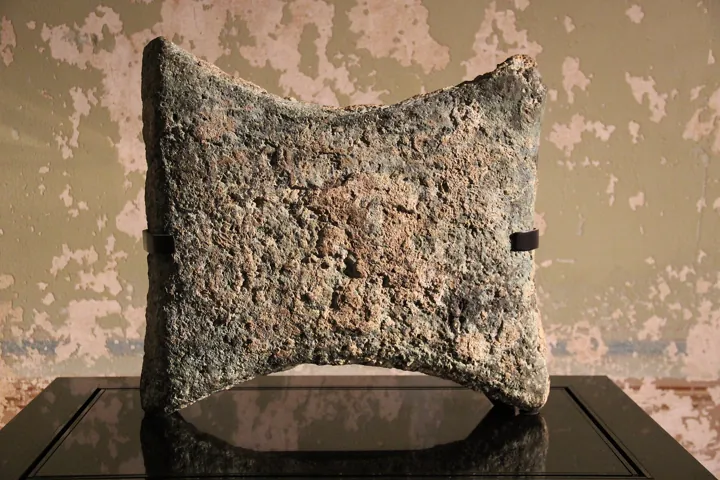
- Description
- Un lingot de cuivre antique en forme de peau de bœuf, exposé dans un musée.
- Source
- Gary Todd · original page
- Licence
- CC0 Public domain
 Expert bias
The more we know about a subject, the surer of ourselves we are, and not necessarily the more right, especially when the problem moves a little beyond familiar ground.
In brief
- What: the expert is overconfident in their judgments and reduces every problem to their own field.
- Why: in-depth knowledge supplies a ready explanation for everything, confidence follows, and one does not always receive feedback on one's mistakes.
- Detect: forecasts with no probability, no date and never checked; a single family of solutions proposed.
- Avoid: ask for probabilities and track them, cross specialties, distinguish what the expert knows from what they sense.
Definition#
 Fictitious illustration
Expert bias covers two neighboring flaws. The first is overconfidence: a specialist judges their own forecasts and analyses to be more reliable than they are. The second is narrowness of frame: they tend to treat every problem with the tools and explanations of their discipline, and to miss solutions that lie outside their field.
The best-known study is that of Philip Tetlock, Expert Political Judgment (2005): over some twenty years, he collected the forecasts of 284 experts in politics and economics (tens of thousands of judgments in all) and compared them with the events. The experts did barely better than chance, and worse than simple extrapolation methods. Those who know one big explanatory principle (the "hedgehogs", in Isaiah Berlin's image) do worse than those who combine several sources and correct their opinion (the "foxes").
Expertise itself is not at issue: it is valuable in a great many fields. The bias appears when we confuse mastery of a technique with the ability to predict or to decide outside it.
The mechanism#
- A ready-made story. The expert has models that explain almost everything, after the fact. It is easy for them to make an unforeseen event coherent, which feeds confidence in their models (see hindsight bias).
- Little reliable feedback. A pilot or a surgeon quickly sees the result of their choices; an analyst, an architect or a consultant waits months or years, with a thousand possible causes. Shanteau (1992), then Kahneman and Klein (2009), showed that expert intuition is reliable in regular environments with fast feedback, and hardly so in unstable environments.
- Blocking by the familiar. With the Einstellung paradigm, Bilalić, McLeod and Gobet (2008) showed that expert chess players, facing a position where a known solution and a better one both exist, do not see the better one: the familiar solution blocks them, without their realizing it.
- The social role. The expert is expected to know: saying "I don't know" or giving a probability of 60% is judged weak. The reward goes to the clear-cut assertion (see authority bias).
- The stakes. Reputation, fees, professional identity: going back on a public position has a cost.
In Expert Political Judgment, Tetlock reports on 284 experts and several tens of thousands of forecasts, between 1984 and 2003. Results: confidence exceeding success (overconfidence); little gain from holding a doctorate or from seniority; media celebrities do worse; the "foxes" do better than the "hedgehogs". The line about a dart-throwing chimpanzee is a journalistic paraphrase that irritated him: the study does not say that experts are useless, but that their long-term forecasts of political events are worth less than people think. Tetlock and Gardner's later work (Superforecasting, 2015) shows that one can improve, through measurement and teamwork.
Where we encounter it#
In project management#
- Architecture: the expert in one style (microservices, relational databases, a language) proposes that style for a problem they have not broken down. The choice is presented as a technical certainty (see the hammer effect).
- Estimating and date forecasting: "I know this type of project, it will be done by June", with a certainty that dispenses with breaking down the work and comparing with the historical record.
- Choice of method: the coach or consultant for a method (agile, V-model, framework) recommends extending it, including to contexts where it applies poorly.
- Reviews and audits: the external expert, brought in on a specific scope, draws conclusions on governance or business topics they know little about.
- Security and operations: the specialist in one risk sees it everywhere, and neglects the risks of another family (human, organizational, contractual).
In management#
- Promoting a technical expert: we assume they will also be a good manager, or that their opinion counts on everything in the team.
- Expert committees: the most senior or most recognized person sets the tone; the others fall into line or stay silent.
- Market, hiring or budget forecasts: credit is given to the confident forecasts of an executive or a firm, without ever comparing past forecasts with what happened.
- Calling in a firm: the consultant recommends what their firm knows how to do.
Famous cases#
The Simon-Ehrlich wager: the scarcity expert versus the economist 1980-1990#
Biases at play: expert's overconfidence in their forecast, single frame of thinking.
What happened. Paul Ehrlich, a Stanford biologist and author of The Population Bomb (1968), announces that growth in population and consumption will exhaust resources, and that their prices will rise. The economist Julian Simon, who argues the opposite, offers to bet him on the price movement of raw materials, chosen by Ehrlich and his colleagues. They pick five metals. The wager is made on September 29, 1980: if, in constant dollars, the $1,000 basket is worth more ten years later, Simon will pay the difference; if it is worth less, Ehrlich will. In 1990, all the constant prices have fallen, and Ehrlich sends Simon a check for $576.07.
What this illustrates
Ehrlich was not incompetent: he was a recognized specialist, and his conviction rested on a coherent model. But that model did not take into account substitution, innovation or price as a signal, which the economist had in mind. An expert, even a serious one, can be sure of themselves outside the conditions in which their model has been tested. Note also that the wager does not show that Ehrlich was wrong about everything or that the trend will continue: it merely illustrates the gap between expressed certainty and verification.
Twenty years of expert forecasts 1984-2003#
Bias at play: expert's overconfidence.
Philip Tetlock asks professionals (academics, advisers, journalists) to assign probabilities to future events (regime changes, growth, conflicts), then waits for them to resolve. The experts are poorly calibrated: the events they judge almost certain happen much less often than that. They do barely better than simple rules ("nothing changes", "the trend continues"), and worse than statistical models. After the fact, they explain their mistakes by "an unpredictable event" or "almost right", without revising their model.
What this illustrates
What makes the difference is neither the degree nor the seniority, but the way of thinking: openness to several sources, revision of opinions, a taste for probabilities. For a project: ask the expert for a probability and a date, write them down, and come back to them. It is the only way to know whether their judgment is better than chance.
Warning signs#
- Forecasts with no probability or deadline, which nobody will ever be able to declare wrong.
- "I've seen it a hundred times" or "it's obvious" in response to a question on which there is no data.
- A single family of solutions proposed, always the one the expert knows how to do.
- An opinion that goes beyond the person's field (an architect on governance, a lawyer on technology) given with the same assurance.
- A disagreement with a non-specialist dismissed because "you're not in the trade".
- The expert's past mistakes are explained ("the exception") rather than counted.
- Nobody in the room dares to contradict the most senior person.
Avoidance reflexes#
- Ask for a probability and a date. "What percentage chance do you give that we'll hit the date?" A quantified answer can be checked; a clear-cut assertion cannot.
- Keep a forecast journal. Write down who predicted what, with what confidence, then compare. After a few months, the gaps speak for themselves.
- Distinguish knowledge from intuition. "What in what you are saying comes from data or a verified rule, and what comes from your experience?" Intuition is useful mainly in a stable environment with fast feedback.
- Cross specialties. Have an architecture proposal reviewed by someone from operations, security, the business. Each sees what the other does not.
- Compare with a reference class. Before the expert's opinion, look at the fate of similar projects: the historical record corrects a certainty (see the planning fallacy).
- Ask for the three other options. "What are the competing approaches, and why is yours better here?" An expert who cannot describe the alternatives may not have compared.
- Seek an outsider's opinion. The naive question ("why not do it more simply?") pushes the expert to spell out their assumptions.
- Reward revision. An expert who says "I changed my mind, here is what I learned" sets an example. Do not call them a weathervane.
With AI: detect, remedy, mitigate#
AI can list the alternatives that an expert does not propose and turn assertions into quantified forecasts to be tracked. But it also imitates the confident opinions it has read, and can seem expert without being so: a confident tone proves nothing, from it as from you.
Detect#
- Spot, in a file or an architecture memo, the assertions with no data or probability.
- Flag the alternative solutions missing from a recommendation.
- Compare the forecasts made with the results, from the journal kept.
Fix#
- Rephrase an assertion as a verifiable statement (probability, deadline, criterion).
- List three to five competing approaches with their conditions of relevance.
- Prepare the questions to ask the expert to bring out their assumptions.
Mitigate#
- Ask for a blind opinion before listening to the expert, to compare.
- Use AI as a non-specialist reader who asks for explanations.
- Have the disagreement between two experts summarized without taking sides.
Prompts to build into your practice#
1. Turn an opinion into a verifiable forecast. After an expert's recommendation, before deciding.
Here is a recommendation or forecast given by an expert: [text].
1. Rephrase each assertion as a verifiable statement: event, deadline, criterion of success or failure.
2. For each one, propose the question to ask the expert so that they give a probability.
3. List the implicit assumptions that the expert has not written down.
4. Say which assertions come from a verified fact, and which come from intuition or experience.
Do not invent any data or reference.
2. Alternatives to the proposed solution. When an expert or a firm recommends a single solution.
I am being recommended the following solution for the following problem: [problem] / [solution].
Give three to five serious competing approaches, specifying for each: under what conditions it is better, what it costs, what it risks.
Then list the questions to ask the expert to find out whether they compared these approaches and what made them choose theirs.
Finally, indicate the pieces of information I would be missing in order to decide, without concluding in my place.
How to build them in#
- Before the meeting: prompt 2 gives the list of questions to ask, including to the in-house expert.
- During: each important forecast is recorded with a probability, using prompt 1.
- After: at the deadline, compare; measurement is the best antidote.
Precautions#
- AI is not one more expert: it can be wrong in a confident tone. Check every reference or figure.
- Do not set the expert aside on the grounds of this bias: the aim is to use them better, not to do without them.
- Do not paste a confidential or contractual file into an unauthorized tool.
Limits#
- Expertise is real and useful in regular environments with fast feedback (medical care, chess, firefighting). Kahneman and Klein (2009) specify the conditions under which an expert's intuition is reliable; the bias mainly concerns long-term forecasts in poorly predictable environments.
- Tetlock's results concern politics and economics; they cannot be extended as is to project management, even if the mechanism is similar.
- The Simon-Ehrlich wager covers ten years and five metals: it does not settle the debate on resources, and over another period the result could have been different.
- Distrusting the expert to the point of deciding without them is the opposite bias.
Sources and verification#
- Tetlock (2005), Expert Political Judgment: How Good Is It? How Can We Know?, Princeton University Press.
- Tetlock & Gardner (2015), Superforecasting: The Art and Science of Prediction, Crown.
- Kahneman & Klein (2009), "Conditions for intuitive expertise: A failure to disagree", American Psychologist, 64(6)
- Shanteau (1992), "Competence in experts: The role of task characteristics", Organizational Behavior and Human Decision Processes, 53(2)
- Bilalić, McLeod & Gobet (2008), "Why good thoughts block better ones: The mechanism of the pernicious Einstellung (set) effect", Cognition, 108(3)
- Simon–Ehrlich wager — dates, metals, $576.07 check (to be cross-checked against the primary sources cited).
- Our World in Data, "The Simon-Ehrlich bet" — price data.
See also#
Related biases#
Variants or cousins: not to be confused.
Counterweights and related reflexes#
What neutralises it.
- Les prévisions chiffrées et suivies (calibrage) (concept or method, no page)
- Le regard d'un non-spécialiste (concept or method, no page)
- The devil's advocate
