

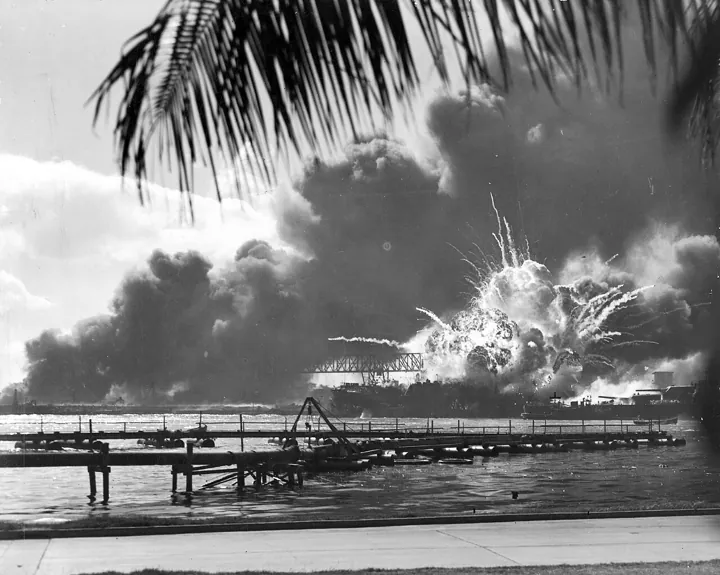
- Description
- The attack on Pearl Harbor, 1941
- Source
- author not stated · original page
- Licence
- PD Public domain
 Hindsight bias
In hindsight, everything seemed obvious: that is what prevents learning from what was not obvious beforehand.
In brief
- What: once we know the outcome, we judge it as more likely than we would have beforehand, and we remember having anticipated it (“I knew it”).
- Why: memory integrates the result into our understanding of the situation and erases the original uncertainty; the mind builds a coherent story that makes the outcome seem inevitable.
- Detect: “it was obvious,” “all we had to do was…,” “how could they not see it?,” in an incident retrospective or a decision review.
- Avoid: record forecasts and reasons before the outcome, reconstruct what was known at the time, consider possible outcomes that did not happen.
Definition#
 Fictitious illustration
 Fictitious illustration
Hindsight bias (hindsight bias, sometimes the “knew-it-all-along effect”) is the tendency, once an event is known, to overestimate the probability we would have assigned to it in advance, and to believe it was predictable. It was demonstrated by Baruch Fischhoff (1975), who described it as “creeping determinism,” a determinism that settles in without us noticing.
Roese and Vohs (2012) distinguish three levels that reinforce one another: memory distortion (“I had predicted that”), the feeling of inevitability (“it couldn't have happened any other way”), and the feeling of predictability (“everyone should have seen it”).
The mechanism#
- Outcome integration: the information “what happened” gets mixed with prior knowledge. It becomes hard to recover the previous state of knowledge.
- Retrospective narrative: the mind looks for causes and warning signs that explain the result; the elements that lead to it are retained, the others fade away.
- Need for coherence and control: believing the event was predictable is reassuring (the world is understandable) and boosts self-image (“I called it”).
Fischhoff has students read a text about a war from 1814-1816 between the British and the Gurkhas of Nepal. One group receives no information about the outcome; four other groups each receive one of four possible outcomes (British victory, Gurkha victory, stalemate without peace, stalemate with peace) as if it were true. Everyone then estimates the probability of each of the four outcomes as they would have judged it without knowing. Participants who were given an outcome judge it significantly more likely than those who were not, and they do not realize it; explicit instructions to ignore the information do not eliminate the effect.
In a related study (Fischhoff and Beyth, 1975), students assess in advance the probability of events tied to President Nixon’s trips to Beijing and Moscow in 1972, then, after the trips, try to recall their estimates: they remember having assigned probabilities closer to the actual outcome than what they had actually written down.
Where you encounter it#
In project management#
- Incident post-mortem: “all we had to do was monitor that metric”; that metric was only one among hundreds, and nothing singled it out before the outage.
- Failed project review: “it was clear the scope was too broad”; that same scope, on a project that succeeded, would not have been criticized.
- Architecture choices: a decision made with the information available at the time is judged by today’s consequences (“why did we choose that tech?”).
- Risk management: a risk that materialized seems to have been “obvious”; those that did not materialize are forgotten (prevention work becomes invisible).
- Estimates: “I said it was too short”: the opinion gets reconstructed after the fact, with no written trace.
In management#
- Decision evaluation: people judge a manager by the outcome (a bad hire, a losing trade-off) rather than by the quality of the decision at the time it was made (see outcome bias).
- Annual reviews: “we knew he was going to leave”; what seems obvious after a departure was not obvious before.
- Recruitment: a candidate who succeeds is the one whose “potential we had sensed”; another, who fails, had “warning signs” that were never mentioned in the interview.
- Blame culture: “how could he not see it?” turns a context error into an individual fault, and pushes everyone to hide their mistakes (see The fundamental attribution error).
Famous cases#
Pearl Harbor: signals or noise? December 7, 1941; 1962 analysis#
Bias at work: hindsight bias (signal-to-noise ratio).
What happened. The Japanese attack on Pearl Harbor, on December 7, 1941, killed about 2,400 Americans. After the fact, several U.S. investigations looked into why warnings had been ignored: intercepted messages, movements of the Japanese fleet, diplomatic tensions. In Pearl Harbor: Warning and Decision (1962), analyst Roberta Wohlstetter shows that these clues, reread with the outcome in mind, form a clear picture. But at the time, they were buried in a huge flow of contradictory intelligence, and other scenarios (an attack elsewhere in the Pacific, for example) seemed more plausible to analysts who were not incompetent. She introduces the contrast between signal (what announces the event) and noise (everything else), which can only be distinguished in hindsight.
What this illustrates
A signal is only a signal once the event is known. In a production incident, the alerts that “announced” the outage were mixed in with thousands of others. Reconstructing what was visible, including the noise, is the only way to know whether there was truly enough to decide differently.
“I knew it would happen”: remembering your forecasts 1975#
Bias at work: hindsight bias, memory distortion.
What happened. The two 1975 works (the Anglo-Nepalese war; Nixon’s trips) establish the bias in its two forms: after-the-fact judgment about an event unknown to the participant, and memory of one’s own forecasts when they were made. In both cases, the known outcome distorts the past, and participants are convinced they remained objective. Later, Fischhoff and Slovic showed that asking people to imagine reasons why a different outcome could have occurred reduces the effect.
What this illustrates
You cannot cancel out the bias through willpower: knowing it exists is not enough. What works is to keep a dated record of what you thought beforehand: a decision note, an estimation range, an identified risk. Without a record, memory rewrites.
Detection signals#
- “It was obvious,” “we should have seen it,” “I told you so.”
- An incident retrospective that identifies a culprit rather than reconstructing the information available at the time.
- No written trace of what had been planned; everyone has a different version of what they thought before.
- Realized risks are always described as predictable, avoided risks as false alarms.
- The quality of a decision is judged only by its result.
Avoidance reflexes#
- Write first. Record the decision, rejected options, assumptions, and a probability (even rough) on the decision date: a short decision journal.
- Reconstruct available information. In a retrospective, establish what was known, by whom, and when, before discussing what went wrong.
- Separate decision and outcome. A good decision can have a bad outcome (and vice versa). Evaluate the process: information used, alternatives, timelines, input requested.
- Imagine other outcomes. Ask: “What else might we have observed? What other explanations would also have held up?” (Slovic and Fischhoff, 1977).
- Ban “all we had to do was…” in incident retrospectives; replace it with “what made this action reasonable at that moment?”.
- Run a pre-mortem. Before kickoff, imagine the project failed and write why: this captures in writing the perceived risks before the outcome.
- Keep numeric forecasts up to date. Record estimate ranges in the tracking tool: comparison with reality is then honest.
With AI: detect, correct, mitigate#
AI is a good formatting tool for decision logs and lessons learned, and a detector of hindsight phrasing. But if you give it the outcome, it will give you a narrative that makes it seem obvious: first give it the information timeline, without the outcome whenever possible. Recent research indicates that language models also show this type of bias when the outcome is revealed to them.
Detect#
- Spot hindsight formulas in an incident report (“all it took,” “obviously,” “we should have”).
- Compare what was documented before the event with what is claimed afterward.
- Flag judgments based only on the outcome and not on the process.
Fix#
- Reconstruct a timeline of what was known at each date.
- Suggest plausible alternative outcomes as of the decision date.
- Rewrite an incident review in blameless language, focused on conditions and decisions.
Mitigate#
- Structure the decision log (context, options, assumptions, probability, review criterion).
- On a fixed schedule, revisit the recorded forecasts to compare them with reality.
- Generate pre-mortem questions before a launch.
Prompts to integrate into your practices#
1. Decision log. To be filled out at decision time, before any outcome.
I need to make this decision: [decision]. Help me draft a decision record dated [date] with: context and constraints; options considered and rejected, with reasons; the assumptions the choice is based on; what would make me change my mind; an estimated probability of success as a range; a review date. Ask me the necessary questions one by one, without inventing content.2. Reconstruct available information. For an incident or project review, before looking for causes.
Here is the timeline of an event, without its outcome: [facts, with dates, and information available at each date].
Tell me, at each step: 1) what the people involved knew and did not know; 2) reasonable interpretations of the situation at that time; 3) signals that would only have appeared as such in hindsight. Do not draw any conclusions from the outcome and do not assign blame to anyone.
3. Detect hindsight formulas. On a lessons-learned text, to review before publication.
Review this report: [text]. Identify passages that express hindsight bias (“obvious,” “all it took was,” “we should have”) or that judge a decision solely by its outcome. For each one, suggest a rewording that describes the situation, the information available, and the reason for the decision at that time. Do not add any facts missing from the text.How to integrate them#
- At decision time: prompt 1 produces the record, which is archived with the date.
- During lessons learned: prompt 2 is run before root-cause analysis; prompt 3 reviews the final report.
- At review time: reopen the decision record and compare it with what happened, without rewriting the record.
Precautions#
- Do not give the outcome to AI before asking it to reconstruct available information: you are biasing it.
- A timeline produced by AI must be validated by those who were there; it may invent cause-and-effect links.
- Incident reports often contain sensitive or personal data: only use an approved tool and anonymize.
Limits#
- The bias is robust but small to moderate in size across studies; it varies by task and is stronger when the outcome is surprising or negative (Roese and Vohs, 2012).
- Recognizing that something was predictable is not always an error: some signals were genuinely clear. The bias is overestimating that clarity.
- For Pearl Harbor, Wohlstetter's interpretation has been debated by other historians, who believe some officials had more clues than she suggests. The case illustrates the difficulty of hindsight judgment, without settling the question of responsibility.
- The exact effect sizes of the 1975 experiments should be read in the papers; they are not repeated here.
Sources and verification#
- Fischhoff (1975), “Hindsight ≠ foresight: The effect of outcome knowledge on judgment under uncertainty,” Journal of Experimental Psychology: Human Perception and Performance — the Gurkha experiment.
- Fischhoff & Beyth (1975), “"I knew it would happen": Remembered probabilities of once-future things,” Organizational Behavior and Human Performance — Nixon's trips.
- Roese & Vohs (2012), “Hindsight Bias,” Perspectives on Psychological Science — synthesis.
- Slovic & Fischhoff (1977), “On the psychology of experimental surprises,” Journal of Experimental Psychology: Human Perception and Performance — the effect of considering other outcomes.
- Hawkins & Hastie (1990), “Hindsight: Biased judgments of past events after the outcomes are known,” Psychological Bulletin.
- Wohlstetter, R. (1962), Pearl Harbor: Warning and Decision, Stanford University Press.
- Dekker, S. (2006), The Field Guide to Understanding Human Error, Ashgate — incident reviews without hindsight.
See also#
Combines with, or reinforces#
These biases feed each other.
Related biases#
Variants or cousins: not to be confused.
- Survivorship bias
- The fundamental attribution error
- Le biais du résultat (concept or method, no page)
Counterweights and related reflexes#
What neutralises it.
- The pre-mortem
- Le journal de décision (concept or method, no page)
