

- Description
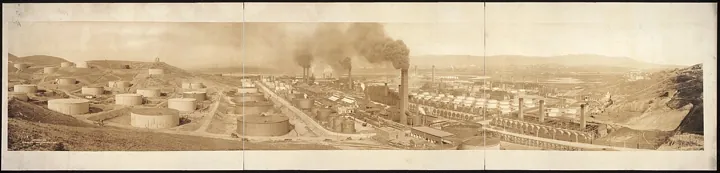
- An oil refinery (old panoramic photograph)
- Source
- West Coast Art Co. · original page
- Licence
- PD Public domain
 Wishful thinking
When the result we hope for is also the one the evidence seems to confirm, we stop checking the evidence.
In brief
- What: we treat as true or likely what we want, and we demand less evidence for what we like than for what we dislike.
- Why: desire steers information seeking, interpretation, and standards of proof; it is stronger when the stakes are high and evidence is ambiguous.
- Detect: a demonstration that's “too good,” a single explanation that suits everyone, objections treated as bad faith.
- Avoid: independent counter-expertise, tests designed to fail, success criteria written before the demonstration, a decision-maker with no stake in the outcome.
Definition#
 Fictitious illustration
Wishful thinking is the formation of beliefs, forecasts, or decisions based on what is pleasant to imagine rather than on facts and reason. It does not require lying or stupidity: desire affects what we look at, how we read what we saw, and the level of rigor we apply before concluding.
It differs from Optimism bias: optimism concerns one's personal future (“we'll be fine”), while wishful thinking applies to facts to be established (“this solution works,” “this vendor is reliable,” “this result is true”).
How it works#
Experimental research on the phenomenon (Krizan and Windschitl, 2007) shows that desire does not directly alter estimated probability, but acts through several pathways:
- Selective search: we look for evidence where it confirms us, and stop as soon as we have enough (see Confirmation bias).
- Variable proof threshold: for what we like, we ask “can I believe it?”; for what we don't like, “must I believe it?”
- Interpreting ambiguity: a fuzzy result is read in the desired direction. Bastardi, Uhlmann, and Ross (2011) showed this with parents of young children who, wanting a particular conclusion, judged contrary studies more harshly.
- Shared stakes: when an entire group (sponsor, vendor, leadership) wants the same outcome, mutual checking disappears.
Where it appears#
In project delivery#
- Proof of concept: a demonstration run on a dataset chosen by the vendor is accepted as proof of feasibility, because everyone wants the solution to work.
- Vendor “black box”: an engine, algorithm, or component whose operation is secret is judged by demos, not by independent verification.
- Acceptance testing: test cases are validated “more or less” to meet the date, hoping the rest will be fine; issues are labeled “minor.”
- Sales forecasts: expected revenue from a new offering is set at the level that makes the investment case acceptable.
- Recovery or migration plan: “the cutover will go smoothly,” without real rehearsal, because the date is fixed.
In management#
- Hiring: a candidate urgently needed is seen as “perfect”; concerns from references are minimized.
- Target setting: a target already promised to leadership is judged achievable; contrary signals are blamed on lack of goodwill.
- Change management: “teams will buy in”; signs of resistance are read as isolated cases.
- Upward reporting: staff learn to report only good news; the decision-maker receives what they want to hear.
Famous cases#
Elf's “sniffer planes” 1976-1979 ; revealed in 1983#
Biases at play: wishful thinking (the beginning: people want to believe), then escalation of commitment (what followed: funding continues); confirmation, authority, and sunk costs as reinforcements.
What happened. In the mid-1970s, after the 1973 oil shock, France sought to reduce its energy dependence. A self-taught Italian inventor, Aldo Bonassoli, and a Belgian aristocrat, Count Alain de Villegas, claimed they had developed processes (called “Delta” and “Omega”) that could detect oil deposits from an aircraft thousands of meters underground. In 1976, leaders of the state-owned oil group Elf-ERAP (Pierre Guillaumat, with former Prime Minister Antoine Pinay) took interest, and the matter was brought to the attention of the Presidency (meeting with Valéry Giscard d'Estaing on June 2, 1976, according to published accounts). A first contract for 400 million francs was signed in May 1976, followed by others, including one for 500 million in June 1978, with a Panamanian company.
The demonstration tests were run over sites already known to Elf engineers; according to accounts, internal company sources had provided the inventors with the needed data, which made test success certain. How the device worked remained secret; according to some accounts, Bonassoli even required that no scientist be present at the first demonstration. In 1978, an external expert commissioned by the group concluded the processes were useless. Physicist Jules Horowitz, from the French Atomic Energy Commission, delivered the decisive demonstration in May 1979: a ruler placed inside the device behind a screen appeared unchanged in the image although it had been altered, proving the device “saw” nothing and reproduced prerecorded images. Contracts were stopped in summer 1979.
The case remained secret for four years. A report by the Court of Auditors, some copies of which were allegedly destroyed, was mentioned in the press, and Le Canard enchaîné revealed it publicly on December 21, 1983; it became a political controversy, with Valéry Giscard d'Estaing defending himself on television. Bonassoli returned to repairing televisions; de Villegas, according to several accounts, withdrew to South America.
The biases that combine. Wishful thinking is the engine: the hope of finding oil without drilling, in a country that has none. Confirmation does the rest: favorable tests are retained, doubts set aside. Authority locks it in: the project is endorsed by top-level figures, which discourages contradiction. Escalation of commitment and sunk costs explain why, even with doubts, subsequent contracts were signed rather than stopping.
What this illustrates
For an IT project, three direct transpositions: (1) a non-independent demonstration is not proof: vendor-selected dataset, prepared environment, known scenarios; (2) a “black box” must be testable from the outside by a third party choosing its own cases; (3) an overly favorable proof of concept is a warning signal, not good news: ask someone to try to make it fail. And when everyone wants the solution to work, desire itself is a risk factor to manage.
When we want a conclusion, we criticize contrary studies more harshly 2011#
Biases at play: wishful thinking, motivated reasoning.
What happened. Anthony Bastardi, Eric Uhlmann, and Lee Ross (2011) studied parents who were shown opposing scientific studies about childcare for young children. Parents who had already made their choice—and therefore wanted it to be the right one—judged the study that contradicted them more harshly than the one that supported them, and their desire showed up in how they evaluated method quality. (Summary of the paper's general idea; protocol details are in the article.)
What this illustrates
What changes is not the quality of the evidence, but the strictness with which we judge it. Acceptance testing or analysis that contradicts what we hope for is subjected to scrutiny that favorable evidence would not have faced: apply the same standard to both.
Detection signals#
- A demonstration that is too successful, on cherry-picked cases, with no surprises or failures.
- The vendor refuses or delays an independent test, or cites trade secrets to avoid explaining how it works.
- Objections are treated as bad faith or resistance to change.
- Everyone in the room (sponsor, team, vendor) wants the solution to work.
- Success criteria were defined after the initial results.
- Bad news no longer makes its way up.
Avoidance reflexes#
- Write success criteria before the demonstration. Datasets, thresholds, conditions: set in advance and in writing, by someone who is not the vendor.
- Have it checked by an independent third party. An expert with no stake in the outcome, who chooses their own cases and can conclude that the solution does not work.
- Design tests to fail. Actively look for edge cases, hostile data, production conditions; a solution that has never failed has not been tested.
- Separate desire from decision. The final decision-maker must not depend on success for their career or budget, or must be supported by someone who does not.
- Apply the same framework to favorable and unfavorable evidence. Ask: “If this result went against what we want, would we accept it just as easily?”
- Run a devil's advocate exercise and a pre-mortem. Imagine the project has failed in a year and write why; assign someone the task of refuting it.
- Plan stopping points. Break the commitment into stages, with objective go/no-go criteria, so you do not commit based on enthusiasm; define in advance what triggers a stop (see Escalation of commitment).
- Reward bad news. A doubt-raiser who was right should be thanked; otherwise no one will say it anymore.
With AI: detect, fix, mitigate#
AI is useful for playing devil's advocate, writing success criteria, and looking for failure cases. But models tend to go along with the user (agreeableness): if you tell it you like the solution, it will confirm that. And above all, AI is itself a “black box” that the desire for automation readily leads us to overrate: apply the rules in this page to it as well.
Detect#
- Identify in a demo or proof-of-concept file the favorable conditions (selected data, prepared environment).
- Flag success criteria defined after the fact.
- Spot in a report objections dismissed without analysis.
Fix#
- Draft success and stop criteria to validate before the demonstration.
- Design hostile test cases for a third-party solution.
- Play devil's advocate: list what could cause the solution to fail.
Mitigate#
- Do a written pre-mortem before launch.
- Prepare the questions to ask a vendor about the verifiability of its product.
- Produce a symmetric reading grid to compare favorable and unfavorable evidence.
Prompts to integrate into your practices#
1. Devil's advocate on a demonstration. After a convincing demonstration or proof of concept.
Here is what a vendor or a team demonstrated to us: [description: tested cases, data used, environment, results].
You are playing devil's advocate. I do not want your opinion on the quality of the solution. List: 1) the conditions that may have made the demonstration more favorable than in production; 2) untested cases that could make it fail; 3) what an independent expert should redo themselves; 4) the five most uncomfortable questions to ask. Do not invent any facts about the solution.
2. Success criteria written in advance. Before any demonstration, acceptance testing, or proof of concept.
We are going to evaluate [solution] for [need]. Help me write, before the demonstration, an evaluation brief: measurable success criteria and their thresholds; the datasets we will choose ourselves, including difficult and hostile cases; realistic environment conditions; what would lead to stopping or rejection; who will validate independently. First ask me the questions you are missing.3. Pre-mortem. Before committing to an investment or vendor choice.
Imagine that, one year from now, [decision or project] has failed spectacularly. Write the ten most plausible causes of this failure, including at least three tied to what we are hoping for too strongly, three tied to insufficiently verified evidence, and three tied to dependency on a third party. For each one, give an early warning signal to monitor and a preventive action.How to integrate them#
- Before the demonstration: prompt 2 sets the evaluation brief, which is signed by the parties.
- After the demonstration: prompt 1 is run immediately, then the questions are asked to the vendor.
- Before commitment: prompt 3 feeds the committee with a written pre-mortem.
Precautions#
- Do not present the solution to AI in a favorable light: it will follow your lead. Describe facts without adjectives.
- AI does not replace an independent counter-expertise: it cannot test the solution for you.
- An AI that details the vendor product's “known risks” may invent them: verify.
- Do not share contract files or vendor data with an unauthorized tool.
Limits#
- The effect of desire on estimated probability is, in experiments, rather modest and depends on the situation (Krizan and Windschitl, 2007). It is more pronounced when evidence is ambiguous and interpretation is flexible.
- Hoping is not a flaw: wanting a project to succeed is motivating. The bias begins when hope lowers the standard of evidence.
- In the oil-sniffer planes affair, the amounts vary by source: around 500 million francs in losses is often cited, while other accounts mention more than one billion francs committed, and the Court of Auditors report speaks of losses above 750 million. Details of the staging of the demonstrations (internal sources that provided the data) come from secondary accounts.
- The inventors deliberately manipulated; the case illustrates decision-makers' vulnerability to fraud, not an authorless error.
Sources and verification#
- Wikipedia (French), “Affaire des avions renifleurs” — timeline, contracts, Jules Horowitz test, revelation on December 21, 1983.
- Wikipedia (English), “Great Oil Sniffer Hoax”.
- Encyclopædia Universalis, “December 21-28, 1983: political controversy around the oil-sniffer planes affair”.
- Time, “France: The Big Stink” (1984) — the controversy and destroyed copies of the report.
- Krizan & Windschitl (2007), “The influence of outcome desirability on optimism”, Psychological Bulletin.
- Bastardi, A., Uhlmann, E. L. & Ross, L. (2011), “Wishful thinking: Belief, desire, and the motivated evaluation of scientific evidence”, Psychological Science, 22(6).
- Kunda (1990), “The case for motivated reasoning”, Psychological Bulletin — motivated reasoning.
See also#
Combines with, or reinforces#
These biases feed each other.
Related biases#
Variants or cousins: not to be confused.
Counterweights and related reflexes#
What neutralises it.
- The pre-mortem
- The devil's advocate
- La contre-expertise indépendante (concept or method, no page)
