

- Description
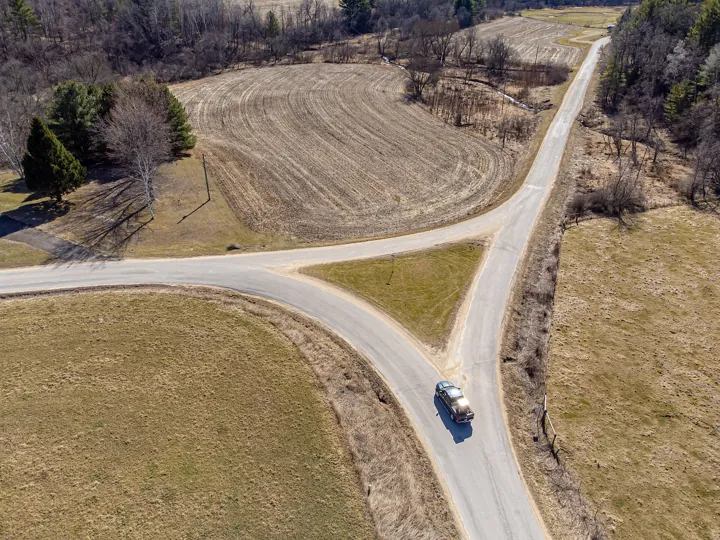
- Un embranchement de routes vu du ciel, où il faut choisir sa direction
- Source
- Wikideas1 · original page
- Licence
- CC0 Public domain
 Choosing Your Method and Hybridizing
You'll know how to choose a method based on context (size, uncertainty, regulation, contract, maturity, data nature) rather than trends, with a decision tree and a table of…
In brief
- You'll know how to choose a method based on context (size, uncertainty, regulation, contract, maturity, data nature) rather than trends, with a decision tree and a switching table.
- You'll know realistic hybridizations: “wagile,” Scrum + Kanban for run operations, predictive framing + agile execution, stage-gate governance + sprints, versioned kits + continuous flow.
- You'll know how to contract an iterative approach (fixed-price with variable scope, two phases, conditional tranches).
- You'll know how to lead method change: start small, measure, avoid the “big bang.”
- You'll identify classic pitfalls and ways to defuse them.
On this page
- 1. A context-based decision tree
- 2. The six dimensions, one by one
- 3. Typical cases and recommended methods
- 4. Realistic Hybrids
- 4.1 “Wagile” (water-scrum-fall): the most widespread, the most criticized
- 4.2 Predictive framing + agile execution
- 4.3 Scrum + Kanban for run (team Scrumban)
- 4.4 Stage-based governance + sprints (PRINCE2/PMI + Scrum)
- 4.5 Predictive for structure, agile for detail
- 4.6 Versioned kits + continuous upstream flow
- 4.7 Hybrid combinations to avoid
- 5. Contracting
- 6. Driving Method Change
- 7. Pitfalls
- 8. AI Contribution
- 9. See Also
Level: 🟢→🔴
1. A context-based decision tree#
🟢 Novice — Choosing a method means answering a few questions in order, starting with what eliminates the most possibilities. Suggested order: external constraints (regulation, contract), then the nature of uncertainty, then the organization (size, maturity).
This diagram is a starting point, not an algorithm. It is intentionally incomplete: it leaves out the human factor and the team's history (see §2 and §7).
If you're hesitating between two branches, it means there are two sub-problems in your project. Split them (by batch, by phase, by flow) and choose for each one: that's where most good hybridizations come from.
2. The six dimensions, one by one#
🟡 Hands-on — For each dimension: the question, what points toward predictive or adaptive, and the pitfall.
2.1 Size#
| Size | Reference point | Direction |
|---|---|---|
| 1 to 3 people | no formal coordination | light Kanban, XP practices; don't import a framework |
| 4 to 9 people (one team) | one team can own everything | Scrum, Scrumban, Shape Up |
| 10 to 30 (2 to 4 teams) | real dependencies | Scrum + coordination (Scrum of Scrums), Nexus |
| 30 to 150 | product portfolio | LeSS, SAFe, value-stream governance |
| > 150 | entire organization | organizational transformation, not just a method choice |
Applying a larger-scale framework in anticipation (SAFe for 12 people). Symptom: more meetings than deliveries. Remedy: return to the minimum coordination that works.
2.2 Uncertainty#
Distinguish three kinds of uncertainty: about the need (what do we want?), about the solution (how do we do it?), about the data (what does it contain?). The fuzzier the need, the more short feedback loops you need; the more uncertain the solution, the more prototypes and spikes you need; the more uncertain the data, the more early profiling you need. Data projects often combine all three.
An indicator “on-shelf availability rate”: clear need (management defines it), known solution (join field readings with a reference dataset), uncertain data (some readings are entered without a store ID). The method should put source profiling as the first milestone, before any schedule commitment.
2.3 Regulation and evidence requirements#
When an auditor, regulator, or customer asks who decided what, when, and based on what evidence, you need traceability. This is not incompatible with agile: an agile team can produce an evidence file (user stories with acceptance criteria, archived test results, decision log) as long as it is planned as work (extended Definition of Done). In a heavy-evidence context (healthcare, rail, regulated finance), the design phase and verification remain sequenced and formal; agile applies within each phase.
2.4 Contract#
The contract is often the real method constraint (see §5). A firm fixed-price contract with detailed scope pushes toward predictive; a time-and-materials or capped-budget contract pushes toward iterative. An internal project (without a contract) leaves more freedom, but the annual budget plays the same role.
2.5 Maturity#
Maturity is read on three axes: technical (automated tests, continuous integration, reproducible deployment), product (a business counterpart able to decide and prioritize), organization (does management accept autonomy?). Rule of thumb: don't add ceremonies where engineering is weak; start by equipping testing and delivery (see CI/CD: Continuous Integration and Delivery). The matrix Continuous Integration and Delivery gives the levels.
2.6 Data nature#
What changes when it's data (details in Methods Specific to Data Projects):
- the increment is reliable data (loaded, reconciled, historized), not a feature: you test numbers;
- historization and replay (idempotence) are structuring decisions and hard to reverse;
- migrations (database version, model, product) are predictable projects with comparative plans and acceptance testing;
- volume and confidentiality constrain test environments;
- the business acceptance tester is the bottleneck (availability, legitimacy);
- reports consumed by third parties (customers tied to a measurement ID, for example) lock in interface contracts: you can't freely rename a measure or a column.
For each project, write a one-page context sheet (size, 3 uncertainties, external constraints, contract, maturity, data nature) and review it at every milestone. Method selection becomes a traceable and revisable decision.
3. Typical cases and recommended methods#
🟡 Hands-on — Cases, with context and default recommendation (to adapt).
| Case | Context | Default recommendation | Watch point |
|---|---|---|---|
| Datamart version migration with functional parity | known scope, comparative acceptance testing possible | Light V-cycle, automated non-regression plan, incremental delivery by domain | don't leave the “comparison” to the end |
| New analysis domain (sales → promotions) | evolving need, business available | Scrum (2-week sprints) with data-driven review | define “increment” = reconciled data |
| Support and routine reporting enhancements | unplanned items, variable sizes | Kanban with classes of service, limited WIP | business acceptance bottleneck |
| Mixed project + support team | 5 people, two workload types | Scrumban with capacity reserved for flow | write the policies |
| Regulatory report (external scope) | mandatory date, evidence required | Predictive framing + iterative execution + evidence file | scope freeze by external rules |
| Sales-support indicator prototype | value uncertainty | Lean startup, MVP = report on extract | criterion for moving to industrialization |
| Shared data platform (3 teams) | dependencies on the reference model | Nexus / Scrum of Scrums + data contracts | owner of the shared model |
| Public procurement with specifications | fixed-price, contractual milestones | V by tranches with intermediate acceptance testing | reintroduce feedback into the contract |
| Industrialization of a prototype | known technical debt | Kanban/Scrum debt-oriented + data tests | reject new features during the recovery period |
4. Realistic Hybrids#
🟡 Practical — Purity is not a goal: almost all high-performing organizations combine approaches. The art is doing it explicitly, without breaking the properties that make each building block work.
4.1 “Wagile” (water-scrum-fall): the most widespread, the most criticized#
An upstream predictive phase (requirements specification, budget, contractual schedule), sprint-based execution, and a downstream predictive phase (formal acceptance testing, batch production release). The term has an ironic tone (water-Scrum-fall) because feedback does not pass through upstream and downstream: sprints optimize what is already locked in.
| Area | Benefit | Risk |
|---|---|---|
| Locked upstream phase | budget, contract, justification | poor anticipation of requirements |
| Sprints in the middle | visible deliveries, internal feedback | feedback with no power to change |
| Block downstream phase | controlled production release process | late acceptance testing, tunnel effect |
Wagile by constraint. Symptom: stable velocity, unhappy users at final acceptance testing. Cause: sprints do not deliver to the user. Remedy: extend agility upstream (co-built backlog, spike-based framing) and downstream (acceptance testing at every review, incremental production releases, automated deployment).
4.2 Predictive framing + agile execution#
Most useful for projects with contracts or annual budgets: a short framing phase (2 to 6 weeks) produces a vision, a scope in envelopes (MoSCoW), a budget and timeline, a target architecture, and source profiling; then execution is iterative within that envelope. Scope varies, the framework does not.
This is the spirit of PRINCE2 + agile or DSDM: governance takes the form of stages with tolerances; within a stage, delivery is iterative. See Predictive Methods (Waterfall, V-Model, Spiral, RUP, PMBOK, PRINCE2, Merise, CMMI) and DSDM.
Set three framing parameters: the envelope (budget, date), the non-negotiable Musts, and the stop rule (if we reach X% of the budget without Y value, we reassess). Steering committees accept iterative work more easily when they keep a right to stop.
4.3 Scrum + Kanban for run (team Scrumban)#
A BI team handling both project work and support:
| Principle | Implementation |
|---|---|
| Reserved capacity | for example, 30% of sprint capacity for support flow (order of magnitude to calibrate over 3 sprints) |
| Separate unexpected-work queue | Kanban board with classes of service and limited WIP; expedite limited to 1 |
| Shared cadence | sprint review and retrospective also cover the flow; lead time and cycle time are tracked |
| Arbitration rule | an incorrect-numbers incident overrides the sprint; every override is tracked and reviewed in the retrospective |
A team of 5 on a datamart: 3 calibration sprints showed support consumed between 20 and 45% (average ≈ 32%). Reserved capacity: 30%, with a documented overrun rule. Expected result: velocity no longer collapses during incident-heavy weeks. (Illustration: numbers to measure against your own history.)
4.4 Stage-based governance + sprints (PRINCE2/PMI + Scrum)#
Governance (business case, tolerances, committee) wraps around sprints. The project manager translates sprint reviews into progress reports for the committee (burn-up, goals achieved); the Product Owner keeps detailed prioritization. Rule: one single dashboard, fed by agile artifacts, not a second reporting set.
4.5 Predictive for structure, agile for detail#
For a large project with dependencies: a master plan (macro milestones, architecture, interfaces frozen first: data contracts) and agile teams executing by domain. Interfaces are where predictive is justified (they are expensive to change); inside modules remains flexible.
4.6 Versioned kits + continuous upstream flow#
When delivery is constrained to installation kits (clients are delivered numbered versions, with installation windows on their side): upstream (development) can be continuous (Kanban, continuous integration on a main branch), while downstream is paced by versions (freeze, stabilization, version acceptance testing, maintenance line). This is a delivery train at the cadence of the version, with a flow inside. You then need to resolve branching (see Branching Strategies) and parallel maintenance of multiple versions.
The freeze that drags on. Symptom: a version's stabilization period lasts longer than development. Cause: too much uncertainty arrives too late in acceptance testing. Remedy: acceptance testing on increments during development, explicit freeze-exit criteria, automated regression suite.
4.7 Hybrid combinations to avoid#
| Combination | Why it fails |
|---|---|
| Sprints + six-month locked plan with feature-level dates | contradiction: sprints become waterfall milestones |
| Scrum + “no business access” | no feedback: Scrum loses its reason for being |
| Kanban + no WIP limits | a board without limits is a bulletin board |
| SAFe + non-decoupled monolithic architecture | dependencies require endless meetings |
| Agile + detailed-scope contract with penalties | the team will be forced to defend scope, not value |
5. Contracting#
🟡 Practical — A contract is a risk-allocation mechanism: who bears overrun risk? In a fixed-price, fixed-scope contract, it's the vendor; in time-and-materials, the client. The challenge in an iterative approach is to allocate uncertainty risk in a way acceptable to both.
| Contract type | How it works | Suitable for | Limits |
|---|---|---|---|
| Fixed-price on detailed scope | price and scope locked | known scope, migration, regulatory work | rigidity; changes become disputes |
| Time-and-materials (time spent) | you pay for allocated resources | high uncertainty, exploration, run | the client bears overrun risk |
| Fixed envelope with variable scope | budget and duration fixed, scope negotiated by priority (MoSCoW) | iterative projects with a framework | requires trust and value-based steering |
| Two phases (framing then delivery) | a short fixed-price to frame, then a contract adapted to what was learned | projects with initial uncertainty | the client must accept not knowing the final price from the start |
| Conditional tranches | firm tranches + tranches confirmed after review | public procurement, large projects | plan an exit point for each tranche |
| Framework agreement with purchase orders | a framework, then ongoing orders | run, recurring enhancements | cost control must be organized |
| Incentive / bonus | variable share tied to outcomes (usage, quality) | long-term partnership | define non-gameable measures |
Clause elements that make a contract compatible with iterative delivery:
- a fixed objective and budget, with an evolving scope governed by a lightweight change procedure (an equivalent swap: add one item, remove one of equal value);
- continuous acceptance testing (sprint review) with objective acceptance criteria (numbers, tolerances);
- a right to exit at each milestone (the client can stop by paying for what has been delivered);
- guaranteed business access (Product Owner availability: this is a client obligation, and should be written down);
- ownership and documentation of deliverables (code, model, scripts, test sets);
- reversibility (knowledge transfer, repository access).
In French public procurement, the competitive bidding requirement and the formalism of the requirements specification push toward predictive approaches; common strategies are tranche-based contracts, framework agreements, and a separate framing phase. Applicable standard clauses (for example, the CCAG related to information and communication technologies) should be verified with legal counsel before any choice: this page is not legal advice.
The “loaned” Product Owner. Symptom: the client signs an agile contract but assigns no one to make decisions. Cause: agile is seen as the vendor's production mode only. Remedy: client involvement is a contractual clause with a named person, time per week, and decision authority.
6. Driving Method Change#
🟡 Practical — Changing methods is a change management project, with its own resistance. The approaches that fail most often: the big bang (change everything on a Monday), training alone (without guided practice), the top-down imposed method (without understanding the “why”).
A realistic five-step path:
- Diagnose: measure the current state (lead time, delivery frequency, defect rate, satisfaction). Without a starting point, no improvement can be demonstrated.
- Choose a pilot scope: a volunteer team, a clearly defined product, a sponsor. Avoid the most critical and the most insignificant project.
- Start with the highest-leverage, lowest-cost practices: visualize work, limit WIP, shorten the acceptance testing loop, automated tests on critical items; then ceremonies.
- Measure and adjust at short intervals (retrospective, review at 6–8 weeks); decide whether to scale, adjust, or stop.
- Scale through proof: pilot results convince more than slides; communities of practice help spread adoption.
Levers to activate: visible sponsor; learning by doing (coaching alongside the team); tool adjustments (boards, workflows in the tracking tool); indicator alignment (don’t keep measuring plan compliance if you want value); addressing fears (everyone’s role changes).
One thing at a time: changing method and tool and organization simultaneously blurs causality. When it works (or not), you don’t know why.
| Change Tracking Indicator | Frequency | Warning Signal |
|---|---|---|
| Lead time (85th percentile) | monthly | stagnates or increases after three months |
| Deliveries per month | monthly | no increase despite sprints |
| Escaped defect rate / figures corrected after delivery | monthly | increases with speed (quality pays for speed) |
| Team engagement (short survey) | quarterly | drops after initial enthusiasm |
| Share of time spent in ceremonies | quarterly | > 15–20 % with no value improvement (benchmark to calibrate) |
Measuring velocity as productivity. Symptom: the team inflates estimates to “increase” velocity. Cause: an estimation instrument turned into a target (Goodhart). Remedy: use flow and delivered value, never velocity to compare or reward. See Project Metrics and Reporting.
🔴 Expert — Resistance has legitimate causes. A project manager sees their control role diminish, a manager sees their visibility threatened, a developer fears exposure of daily output. Ignore them, and you lose. Listen to them, and you often discover a real governance need that the new method must serve differently (reports derived from artifacts, portfolio reviews). The Team and Collaboration matrix and the Adoption and Change Management theme provide guidance.
7. Pitfalls#
🟡 Practical — Classic selection and hybridization mistakes, with symptom, cause, and remedy. The general catalog is in Project Management Pitfalls and Best Practices (Cross-Cutting Summary).
| Pitfall | Symptom | Cause | Remedy |
|---|---|---|---|
| Choosing based on hype | adopting the method of a famous company | imitation without context | context sheet + weighted grid (comparison) |
| One method for everything | the same framework for migration, exploration, and run | administrative uniformity | choose by batch / flow |
| Ceremonies without technical practices | lots of meetings, growing debt | engineering side forgotten | start with testing and continuous integration |
| Hybridizing without writing it down | everyone applies their own version | “we adapt” with no trace | explicit policies, shared definition of “done” |
| Changing method during a crisis | disorganization during a peak | hope of catching up | change after the milestone; otherwise stabilize first |
| Ignoring the contract | scope tensions | underestimating contractual weight | engage legal/procurement from the selection stage |
| No stop rule | the project continues without value | no go/no-go review | stage-based stop criteria |
| Importing code methods into data without adaptation | sprints that deliver code but no reliable numbers | “increment” poorly defined | Definition of Done data: reconciled figures, up-to-date model doc, kit installed on a clean database |
| Over-optimizing the choice | weeks of debate | perfectionism | reversible decision: set an 8-week review checkpoint |
Treat method selection as a reversible decision (“two-way door”): test for 6 to 8 weeks, measure, adjust. The only exception: a signed contract, which is a one-way door — hence the importance of the scoping phase before signing a fixed-price agreement.
🧪 Example of a tracked decision — Context sheet for a work batch: Batch “new family of shelf-length measures” — team of 5, business availability 2 h/week, evolving need, stabilized source, no external contract, quarterly kit deliveries, medium technical maturity (partial data tests). Choice: 2-week Scrum, metrics-based review with the business each sprint, Definition of Done including reconciliation and release note; method review in 8 weeks; alert criterion: more than 20% of sprint consumed by support → switch to Scrumban.
8. AI Contribution#
🤖 AI — Can prepare and support the decision; does not make it.
| Use Case | Gain | Risk | Maturity | Prerequisites | Guardrails |
|---|---|---|---|---|---|
| Drafting the context sheet from interviews | 3/5 | 2/5 | 4/5 | interview notes | team validation |
| Calculating flow indicators (lead time, WIP, throughput) | 4/5 | 2/5 | 4/5 | clean board export | sample-based verification |
| Proposing standard clauses for an iterative contract | 2/5 | 5/5 | 2/5 | — | never without legal counsel: high legal risk, hallucinated text |
| Summarizing retrospectives to detect patterns | 4/5 | 2/5 | 3/5 | anonymized minutes | avoid personally identifiable data |
| Preparing a change communication plan | 3/5 | 2/5 | 4/5 | stakeholder mapping | review and adjust to local tone |
Example prompt: “Based on these 12 retrospectives, group recurring pain points by theme (acceptance testing, dependencies, tools, workload), count their frequency, and propose three six-week experiments with a success indicator.”
Limits: AI has no memory of your context, ignores internal politics, and readily suggests “balanced” answers that avoid difficult choices. See AI for Project Management (General, Then Data).
9. See Also#
- Methods: Predictive Methods (Waterfall, V-Model, Spiral, RUP, PMBOK, PRINCE2, Merise, CMMI) · Agile and Lean Methods (Manifesto, Kanban, XP, Lean, Shape Up, DSDM, SAFe, DevOps…) · Methods Specific to Data Projects · Project Management Methods Comparison.
- Scrum: Scrum Framework (Scrum Guide 2020) · Scrum in Practice · Scrum Applied to Data, BI, and Datamarts · Project Management Fundamentals.
- Delivery: CI/CD: Continuous Integration and Delivery · CI/CD for Data: Databases, Datamarts, Pipelines, and Reports · Project Management Pitfalls and Best Practices (Cross-Cutting Summary).
- Tools: Branching Strategies · Azure DevOps Server (Formerly TFS) In Depth · Planning Tools Comparison.
- Maturity: Governance and Steering (GOU) · Scoping and Vision (CAD) · Budget, Value, and Benefits (VAL) · Lead Time and Industrialization (DataOps).
- Glossary · Rating: How to Read Scores, Ratings, and Legend.
✻ Written by Claude Sonnet 5.5
