

- Description
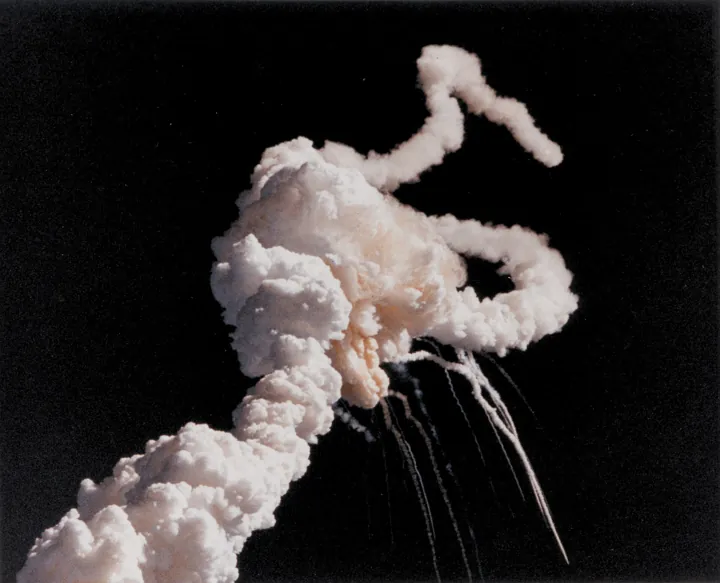
- Panache de fumée de l'explosion de la navette spatiale Challenger dans le ciel
- Source
- NASA / Kennedy Space Center · original page
- Licence
- PD Public domain
 The great scandals and failures caused by biases
Brilliant organizations, recognized experts, sometimes deadly consequences: cognitive biases are not a laboratory curiosity.
In brief
- A map: the more cases a country has cited, the bigger its bubble; the number is inside the bubble.
- A list: each case is summarized in one sentence and links to its entry.
- It is not an inventory: only the cases cited by the site's entries appear.
On this page
- Why understanding biases matters
- Where did they take place?
- Hanoi: the rat tails 1902
- Pearl Harbor: signals or noise? 1941
- The Sydney Opera House 1957-1973
- The Bay of Pigs 1961
- Concorde 1962-2003
- The Shoreham nuclear power plant 1966-1994
- Elf’s “sniffer planes” 1976-1979
- Tenerife: the collision of two Boeing 747s 1977
- New Coke 1985
- The Challenger space shuttle 1986
- The Vancouver World’s Fair (Expo 86) 1986
- The Denver airport baggage system 1993-1995
- Ford and Firestone 2000-2001
- After 9/11: the car rather than the plane 2001-2002
- The Segway 2001-2020
- Theranos 2003-2022
- The Madrid fingerprint and Brandon Mayfield 2004
- Sears: business units competing with each other 2005-2018
- Berlin Brandenburg Airport 2006-2020
- Wells Fargo: accounts opened to hit the quota 2011-2016
- Google Glass 2012-2015
- J.C. Penney and the end of crossed-out prices 2012-2013
- Knight Capital 2012
- Amazon: a résumé-screening tool that reproduces the past 2014-2018
- Equifax 2017
- GitLab.com: five backups, none usable 2017
- The 15,841 cases lost by a spreadsheet 2020
- The OVHcloud fire in Strasbourg 2021
Why understanding biases matters#
We often assume that serious errors come from incompetence, negligence or bad faith. The cases below tell a different story: competent teams, experts, seasoned executives who went wrong in the same way as anyone else, in situations where pressure, enthusiasm, hierarchy or the wish to believe good news distorted judgment.
The scale of the consequences is no anecdote. An opera house that costs fourteen and a half times its estimate, an airport that opens nine years too late, a power plant abandoned after more than five billion dollars, a bank that opens millions of accounts nobody asked for, a shuttle whose engineers' reservations are set aside the day before launch, hundreds of deaths at an airport or on the roads: these are costs in money, in trust, sometimes in lives.
And above all, these errors are predictable. The same mechanisms recur from one case to the next: we underestimate, we cling to what we have already invested, we look for what proves us right, we dare not contradict the boss, we measure what can be counted rather than what counts. Because they are regular, we can recognize them, and we can put safeguards in place: outside view, pre-mortem, devil's advocate, stopping criteria set in advance, cross-checked measures (see the methods).
Understanding biases does not make you infallible: it lets you build organizations that err less, and recover sooner.
This page does not catalog all scandals or all disasters linked to biases, far from it. It only draws on the cases cited by the site's entries, chosen because they are well documented and clearly illustrate a bias. It is neither a ranking of the worst affairs nor proof that one country is more affected than another: the distribution on the map reflects the cases selected, not reality. Several cases have multiple causes, sometimes debated (Challenger, for example): the bias at issue is a reading of the case, not its complete explanation. For each one, the entry gives the sources.
Where did they take place?#
Hanoi: the rat tails 1902#
A bounty on each rat tail turned in encouraged people to breed rats or release them without their tails: the indicator became the target.
See the case in the entry: Goodhart's law (visibility bias) →
Pearl Harbor: signals or noise? 1941#
2,403 Americans killed on December 7, 1941; in hindsight, the warnings seem obvious, whereas they were drowned in noise.
The Sydney Opera House 1957-1973#
Estimated at A$7 million, completed for A$102 million (×14.6), ten years behind the announced schedule.
The Bay of Pigs 1961#
A landing of about 1,400 Cuban exiles crushed in three days, with more than 1,100 prisoners: a plan whose flaws were apparently not seriously debated, according to Janis’s analysis.
Concorde 1962-2003#
A Franco-British program estimated at about £70 million at the start, at more than £1.5 billion by 1976: they carried on because they had already spent so much.
The Shoreham nuclear power plant 1966-1994#
Announced at $75 million in 1966, abandoned in 1994 after costing more than $5 billion (according to Ross and Staw).
Elf’s “sniffer planes” 1976-1979#
For three years, a large state-owned oil group funded, for hundreds of millions of francs, a process supposed to detect oil from an airplane; the hoax was revealed to the public in 1983.
Tenerife: the collision of two Boeing 747s 1977#
583 dead, the deadliest collision in aviation: a flight engineer doubts, the captain decides.
New Coke 1985#
Launched on April 23, 1985 after tests with nearly 200,000 consumers, replaced as early as July 11 by the return of the old formula: they had tested the taste, not the need.
The Challenger space shuttle 1986#
Disintegration 73 seconds after liftoff, seven dead; the day before, the engineers’ reservations about a cold-weather launch were set aside. Cause and decision dynamics are debated.
The Vancouver World’s Fair (Expo 86) 1986#
A deficit far heavier than planned: executives and public authorities kept putting in funds despite the signs of overrun, because the event was defended as a prestige project.
The Denver airport baggage system 1993-1995#
Opening planned for October 29, 1993, actually on February 28, 1995 (about 16 months later) because of an automated baggage system that was too complex, abandoned in 2005.
Ford and Firestone 2000-2001#
Recall of 6.5 million tires in 2000, 174 deaths linked to the tires according to investigations: each blamed the other.
After 9/11: the car rather than the plane 2001-2002#
About 353 additional deaths on American roads in the fourth quarter of 2001, according to a first estimate: fear of flying shifted travelers to the road.
The Segway 2001-2020#
About 100,000 sales hoped for in the first year, about 6,000 actual, after a promise to transform cities.
Theranos 2003-2022#
Valued at up to $9 billion on the strength of prestige: the founder was found guilty of defrauding investors in January 2022.
The Madrid fingerprint and Brandon Mayfield 2004#
A Portland lawyer arrested on May 6, 2004 on a fingerprint judged “certain” by the FBI, released when the Spanish police established that it belonged to someone else.
Sears: business units competing with each other 2005-2018#
A group split into units meant to behave like separate companies, which fought over resources; Chapter 11 on October 15, 2018.
See the case in the entry: Local optimization ("end of the chain") →
Berlin Brandenburg Airport 2006-2020#
Opening announced for October 2011, actually on October 31, 2020; about €2 billion announced, nearly 7 in the end.
Wells Fargo: accounts opened to hit the quota 2011-2016#
About 2 million questionable accounts, 5,300 employees fired, $185 million in fines announced on September 8, 2016.
See the case in the entry: Goodhart's law (visibility bias) →
Google Glass 2012-2015#
Connected glasses launched at $1,500 in 2013; sales of the “Explorer” edition stopped in January 2015.
J.C. Penney and the end of crossed-out prices 2012-2013#
With no crossed-out reference price against which to gauge the bargain: sales down 24.8%, net loss of about $985 million.
Knight Capital 2012#
In 45 minutes, on August 1, 2012, more than 4 million orders sent to fill 212 client orders: a loss of about $460 million.
Amazon: a résumé-screening tool that reproduces the past 2014-2018#
An automatic résumé-scoring tool, trained on ten years of mostly male hires, penalized certain profiles; project abandoned in early 2018.
Equifax 2017#
The patch released on March 7, 2017 was not applied; the intrusion began on May 13 and was only detected on July 29.
GitLab.com: five backups, none usable 2017#
About 300 GB deleted by mistake; the backups that were relied on were of no use: about six hours of data lost.
The 15,841 cases lost by a spreadsheet 2020#
Positive cases not counted from September 25 to October 2, 2020: an .xls spreadsheet limited to 65,536 rows was used as the transfer tool.
The OVHcloud fire in Strasbourg 2021#
A data center destroyed on March 10, 2021: about 3.6 million websites offline (Netcraft), data lost for good for some customers.
